Anúncios
The Foster Child Grant provides crucial financial support to care for a child placed in your custody by a court. It is a monthly payment from SASSA.
This grant is specifically for children who are legally considered foster children. This means a Children’s Court has officially placed them in your care.
Here, we’ll explain who qualifies, how the court order works, and exactly how to apply for the grant. Let’s get you the support you need.
What is the Foster Child Grant?
The Foster Child Grant is a social grant from the South African Social Security Agency (SASSA). It helps foster parents with the costs of raising a foster child.
It acknowledges the big responsibility you’ve taken on. This money is meant to cover the child’s basic needs like food, clothing, and school costs.
It’s important to know this is not the same as a Child Support Grant. The key difference is the legal requirement of a valid court order.
Who Qualifies for the Foster Child Grant?
To qualify for this grant, both the foster parent (the applicant) and the child must meet specific requirements set by SASSA and the law.
Let’s break down the rules for each person involved. Having this clear helps you know if you are eligible before you start the process.
Requirements for the Foster Parent:
- You must be a South African citizen, permanent resident, or a recognised refugee.
- You must live in South Africa with the foster child.
- You must have a valid court order that officially places the child in your care.
Requirements for the Foster Child:
- The child must be under the age of 18.
- The child must be legally placed in your care by a court.
- The child must not be cared for in a state institution.
- The child must live with you, the foster parent.
Important: There is no income test for the foster parent. Your salary does not affect whether you qualify for this specific grant.
Understanding the Court Order: The Most Important Step
You cannot apply for a Foster Child Grant without a court order. This is a non-negotiable legal document issued by a South African Children’s Court.
This order proves that you are the child’s legal foster parent. It’s the result of a legal process to ensure the child is in a safe and suitable home.
A social worker from the Department of Social Development (DSD) will investigate your circumstances. This is to make sure your home is right for the child.
The social worker’s report is presented to a magistrate at the Children’s Court. The magistrate makes the final decision to grant the foster care order.
The court order has an expiry date. Usually, it is valid for two years, but this can vary. You must pay close attention to this date.
How to Apply for the Grant: A Step-by-Step Guide
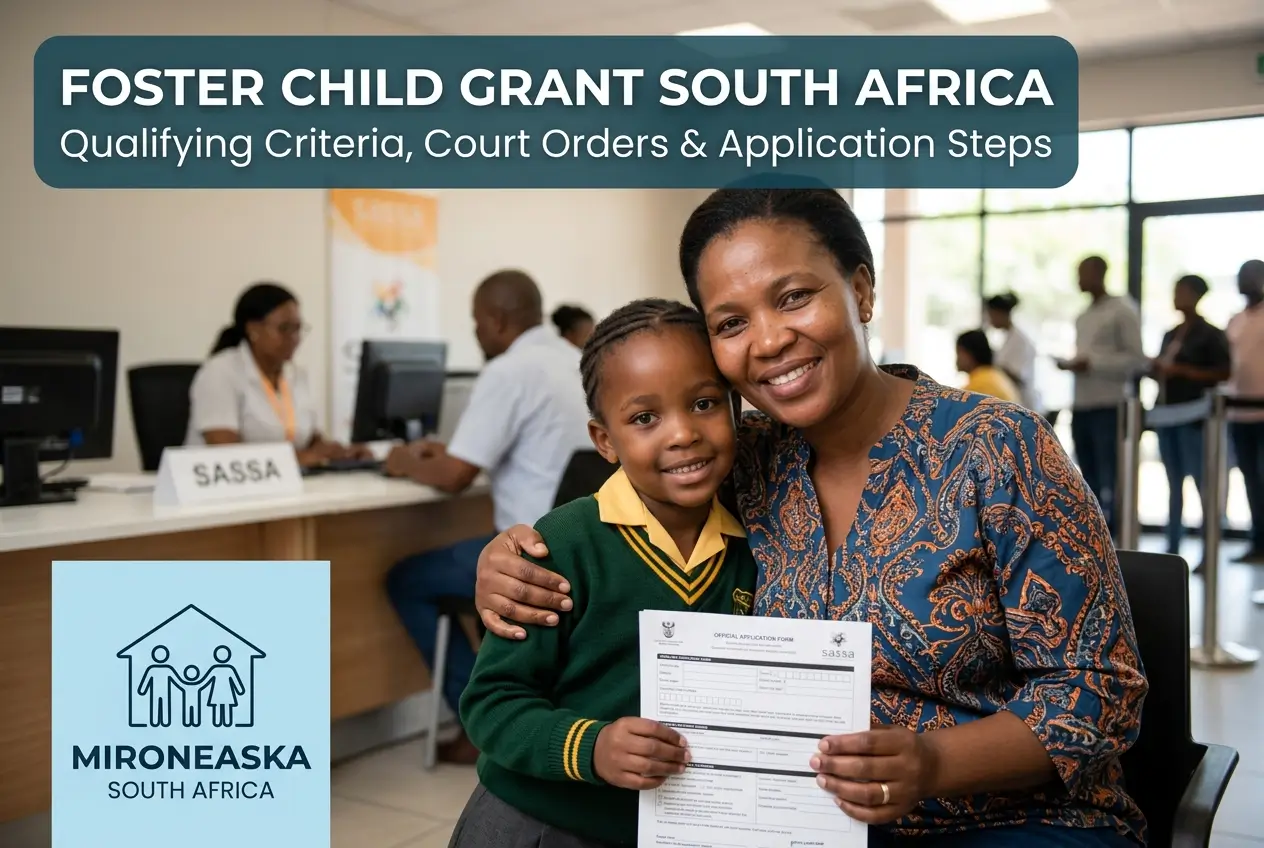
Once you have the court order, you can apply for the grant at your nearest SASSA office or an associated outreach point.
The process is free of charge. You should never pay anyone to help you apply for a SASSA grant. Here is what you need to do:
- Get the application form: You can get this from any SASSA office. A SASSA official can help you complete it if you have trouble reading or writing.
- Gather your documents: Make sure you have all the required documents for yourself and the child. We will list these in the next section.
- Go to your nearest SASSA office: Submit the completed form and all supporting documents in person.
- Complete the interview: A SASSA official will interview you to verify your information. They will also take your fingerprints.
- Get a receipt: After submitting, you will be given a dated receipt. Keep this receipt safe as it is your proof of application.
If you are too old or sick to apply in person, you can nominate a trusted person to apply on your behalf. They will need a letter from you and a doctor’s note.
What Documents Do You Need to Apply?
Being prepared with the correct paperwork will make your application much smoother. You will need original documents or certified copies.
Here’s a checklist of what to bring with you to the SASSA office.
For the Foster Parent (You):
- Your 13-digit bar-coded Identity Document (ID). If you don’t have an ID, you must provide an affidavit.
- Proof of your marital status (if applicable), such as a marriage certificate.
For the Foster Child:
- The child’s birth certificate with a valid ID number.
- The original, valid court order that places the child in your care.
- The child’s school records, if they are of school-going age.
- Records of the child’s clinic visits or health card, if available.
Grant Amount, Payments, and Processing Time
As of the latest SASSA update, the Foster Child Grant amount is R1,180 per child per month. This amount can be adjusted annually.
If your application is approved, you will be paid from the date the court placed the child in your care. This is an important detail.
Processing a grant application can take up to 3 months. SASSA needs this time to verify all the information you have provided.
You can choose how to receive the money:
- Cash: At a specific pay point on a particular day.
- Bank Deposit: Directly into your bank account. This is often the safest option.
- SASSA Card: Through a SASSA payment card.
You can check the status of your application by calling the SASSA toll-free number at 0800 60 10 11. Have your ID number and reference number ready.
Your Responsibilities as a Foster Parent
Receiving the grant comes with responsibilities. The money must be used for the well-being and best interests of the foster child.
This includes ensuring the child has proper housing, nutrition, clothing, healthcare, and education. You are accountable for how the funds are used.
SASSA can review the grant to ensure the circumstances haven’t changed. You must inform SASSA of any changes, such as if the child no longer lives with you.
Misusing the grant money is a serious offence and can lead to legal consequences. The grant is a tool to help you provide the best possible care.
What Happens When the Court Order Expires?
The Foster Child Grant is directly linked to the court order. When the court order expires, the grant payments will stop automatically.
It is your responsibility to start the process of extending the court order before it expires. You should contact your social worker well in advance.
The social worker will need to compile a new report for the Children’s Court to show that you are still providing good care for the child.
Action needed: Contact the Department of Social Development at least three months before the court order expires to start the renewal process.
If the court grants an extension, you must take the new order to SASSA to ensure the grant continues without interruption.