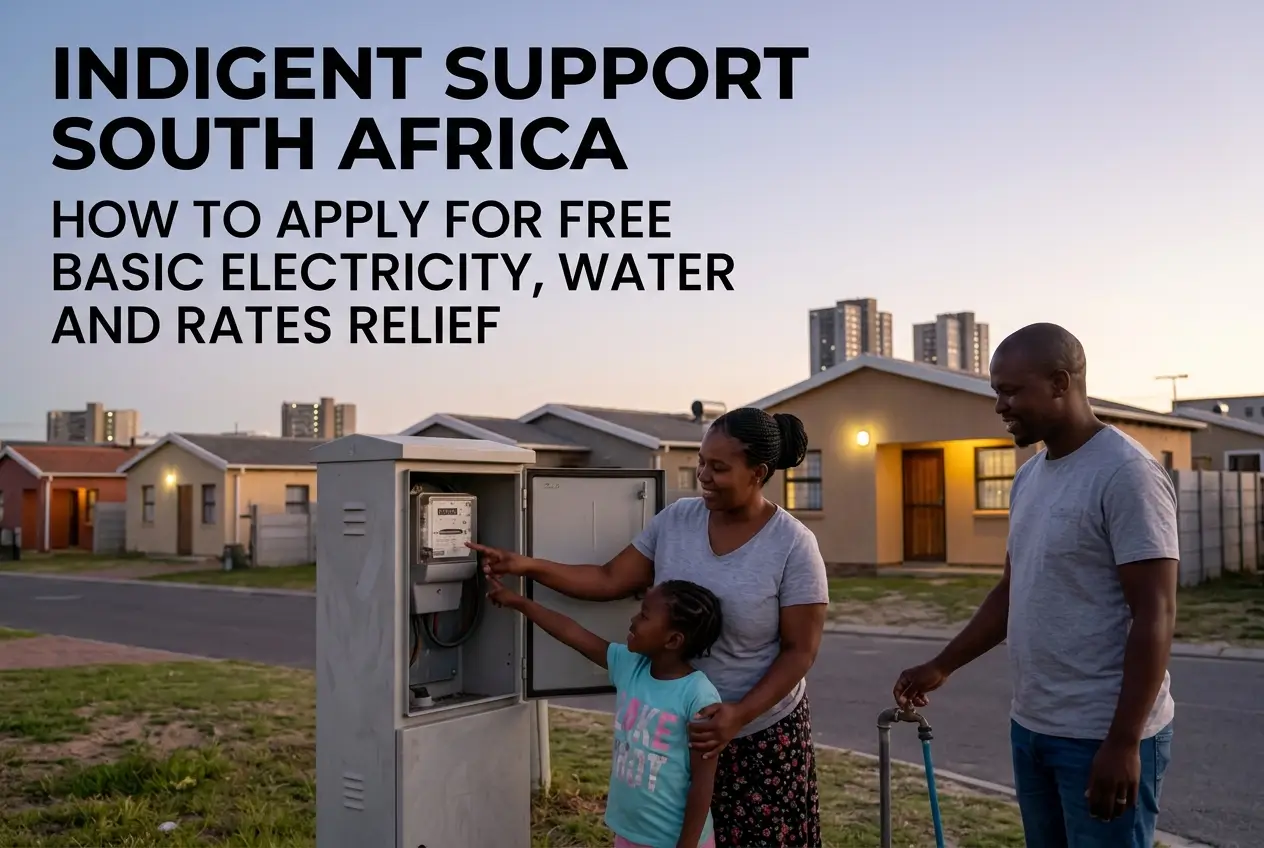
Struggling with municipal bills? You may qualify for government help with free basic water, electricity, and rates relief through the Indigent Support Policy.
This programme is designed for households with very low income. It ensures access to essential services that many find hard to afford.
This guide explains exactly how the support works, who can apply, and the steps to get relief on your municipal account.
What is the Indigent Support Policy?
The Indigent Support Policy is a government programme managed by local municipalities across South Africa. Its goal is simple: to help poor households.
It provides a package of “Free Basic Services” to ensure everyone has access to a basic level of water, electricity, sanitation, and refuse removal.
A household is considered “indigent” if its combined income falls below a certain level set by the local municipality. This means the family cannot afford to pay for these essential services.
This support is based on the constitutional right of every South African to have access to basic services, regardless of their financial situation.
Who Qualifies for Free Basic Services?
Eligibility criteria are set by each individual municipality. This means the rules in Johannesburg might be slightly different from those in Cape Town or Durban.
However, the general requirements to be registered as an indigent household usually include the following conditions.
- Low Household Income: The total income of everyone living in the house must be below a threshold. This is often set at the value of two state pensions.
- Municipal Account Holder: The person applying must be the registered owner or tenant responsible for the municipal account.
- South African Citizen: You must be a South African citizen or have a permanent residency permit.
- Primary Residence: The property must be your main home. You generally cannot get this support for a second property or a business.
- Vulnerable Groups: Municipalities often prioritise households headed by pensioners, people with disabilities, or children.
Crucial Tip: Always check your local municipality’s website or visit their office to confirm the exact income limit and rules in your area.
What Exactly Do You Get with Indigent Support?
If your application is approved, you will receive a package of free basic services every month. The national government sets minimum standards for this support.
Here’s a breakdown of what a registered indigent household typically receives, although amounts can vary slightly between municipalities.
- Free Basic Water (FBW): At least 6,000 litres (6 kilolitres) of free water per household, per month.
- Free Basic Electricity (FBE): At least 50 kilowatt-hours (kWh) of free electricity per household, per month.
- Free Basic Sanitation (FBS): Access to basic sanitation infrastructure and services without charge.
- Free Basic Refuse Removal (FBRR): Your household’s refuse will be collected weekly at no cost.
- Property Rates Relief: You may receive a full exemption or a significant rebate (discount) on your property rates.
Any services you use above these free amounts will be billed to you. The goal is to cover essential needs, not unlimited usage.
How to Apply: A Step-by-Step Guide
Applying for indigent support requires you to formally register with your municipality. The process is designed to be straightforward, but you must follow the steps carefully.
Here is the general process to follow. Remember to contact your local municipal office to confirm any specific procedures they might have.
- Visit Your Municipal Office: Go to the main municipal building or a designated satellite office. Ask for the finance or customer care department.
- Request the Application Form: Ask for the “indigent support” or “free basic services” application form.
- Complete the Form Accurately: Fill in all sections of the form. Provide details about your household members, income, and property.
- Gather All Required Documents: Collect all the necessary paperwork. A list of common documents is provided in the next section.
- Submit Your Application: Hand in the completed form and all your documents to the correct official.
- Get Proof of Submission: Always ask for a stamped copy of the form or a reference number as proof that you have applied.
Some municipalities now offer online application portals. Check your local council’s website to see if this is an option for you.
Documents You Will Need for Your Application
To verify your eligibility, the municipality needs proof of your identity and financial situation. Having these documents ready will speed up the process.
Make sure to provide certified copies where required. You can get documents certified at any police station or Post Office.
- Applicant’s ID: A certified copy of your green bar-coded ID book or Smart ID card.
- Spouse’s and Dependents’ IDs: Certified copies of IDs for your spouse and any other adults living in the house. Birth certificates for children.
- Proof of Income: Recent payslips, a letter from your employer, or a sworn affidavit if you are unemployed.
- Pension or Grant Proof: SASSA card or a recent statement showing your grant payments.
- Bank Statements: Usually the last three months of bank statements for you and your spouse.
- Municipal Account: Your most recent municipal bill that shows your name and address.
- Proof of Residence: If you are not the property owner, you may need a lease agreement or a letter from the landlord.
What Happens After You Apply?
After you submit your application, the municipality will begin a verification process. They need to confirm that all the information you provided is true and accurate.
This process may include checking your details against databases from Home Affairs, SARS, and SASSA. A municipal official might also conduct a home visit.
You should receive a written response within a reasonable time, usually 30 to 60 days. This letter will either confirm your approval or state the reasons for rejection.
If you are approved, the free basic services and rates relief will be applied to your municipal account from the date specified in the letter.
If your application is rejected, the letter must explain why. You have the right to appeal this decision. The appeals process should be explained in the letter.
Common Mistakes to Avoid in Your Application
A simple mistake can cause delays or lead to your application being rejected. Pay close attention to these common errors to ensure a smooth process.
- Incomplete Forms: Make sure every single section of the application form is filled out. Do not leave any blanks.
- Missing Documents: Double-check that you have included all the required documents before submitting your application.
- Uncertified Copies: If the form asks for certified copies of your ID or other documents, make sure they are properly certified and dated.
- Not Declaring All Income: You must declare all sources of income for the entire household. This includes wages, grants, and informal earnings.
- Outdated Information: Use your most recent payslips, bank statements, and municipal account. Outdated documents will not be accepted.
Warning: Providing false information on your application is a criminal offence and can lead to legal action and disqualification from future support.
Keeping Your Indigent Status: The Annual Review
Receiving indigent support is not a once-off approval. Your status is typically valid for 12 months at a time. This is because your financial situation can change.
The municipality will conduct an annual review. You will be required to update your information to prove that you still qualify for the support.
You must inform the municipality immediately if your circumstances change during the year. For example, if you find a job or someone in the house starts earning an income.
Failure to re-apply or update your details can result in your free services being terminated. Keep track of your review date to avoid any interruptions.
Where to Find Help and More Information
The best place to get help is directly from the source. Your local municipality is responsible for managing the indigent support programme in your area.
- Your Local Municipal Office: Visit the customer service centre for forms, submission help, and specific information about your account.
- Your Ward Councillor: Your local councillor can provide guidance and assist you if you are having trouble with the application process.
- Municipal Website: Most municipalities have websites with a dedicated section for indigent support, including forms and contact details.
- CoGTA Website: The Department of Cooperative Governance and Traditional Affairs (CoGTA) website has national policy documents and information.
Don’t be afraid to ask questions. Municipal officials are there to help you understand the process and complete your application correctly.
Taking the time to apply can make a huge difference in your monthly budget. Gather your documents and visit your municipal office to see if you qualify for this vital support.